DM Flow
This course is also available as a consolidated GPT for interactive queries. You can access it here: IIFT Digital Marketing Course
1. Foundation: Business & Marketing First
- Right to Win: Before any digital execution, you must define why you deserve to win. This comes from a superior Product, a smarter Price strategy, a more accessible Place (distribution), or more compelling Promotion (brand story). Without a clear advantage, digital marketing becomes an expensive, uphill battle. (See Chapters [2](/chapter-2) & [3](/chapter-3))
- Business Model: Understand how your business creates, delivers, and captures value using tools like the Business Model Canvas. This clarifies how marketing fits into the bigger picture. (See Chapter [2](/chapter-2))
- Customer Lens: Don't just sell products; solve problems. Understand the "job" customers are hiring your product to do. A deep understanding of their journey and buying behaviors is your greatest source of opportunity. (See Chapter [3](/chapter-3))
2. The Four Levers of Digital Marketing
Digital marketing is a system of four interconnected levers. Success requires managing all four, not just one or two. (See Chapter [4](/chapter-4))
- Reach / Media – Get in front of the right customers
- * Who: Define your best and second-best audiences by understanding your Total, Serviceable, and Obtainable Market (TAM/SAM/SOM). (See Chapter [5](/chapter-5))
- * Where: Choose channels based on intent. Use Search for high-intent users, Social/Profile for awareness, and Contextual for placing your message in relevant environments. (See Chapter [9](/chapter-9))
- * How Much: Your primary goal is not a low cost-per-click, but a profitable CAC/LTV ratio.
- Communication / Messaging – Say the right things
- * What: Your message must adapt to the customer's stage in the funnel. Use educational content for awareness, social proof for consideration, and clear offers for conversion. (See Chapter [6](/chapter-6))
- * How: Maintain a consistent brand voice, but tailor the format (video, image, text) and tone to the platform. Use storytelling to make your message memorable. (See Chapter [10](/chapter-10) & [14](/chapter-14))
- * Trust: Embed trust signals (reviews, testimonials, guarantees) at every step.
- Infrastructure / Assets – Build a solid foundation
- * Owned: Your website, app, and content library are your core assets. They must be fast, secure, and mobile-first. A logical site architecture is critical for both users and SEO. (See Chapters [7](/chapter-7) & [12](/chapter-12))
- * Data: A well-integrated system of a CRM, Marketing Automation Platform (MAP), and a clean Data Layer is non-negotiable for scaling and personalization.
- * Budgeting: Allocate ~25% of your initial budget to building robust infrastructure; this drops to 10-15% in subsequent years. (See Chapter [17](/chapter-17))
- KPIs & Measurement – Track, analyze, and optimize
- * Hierarchy: Your KPIs must form a tree: Business Goals (e.g., Revenue) → Marketing Objectives (e.g., Leads) → Channel Metrics (e.g., CTR, CPL). (See Chapter [8](/chapter-8))
- * North Star: Your ultimate measure of success should be the CAC/LTV ratio. It tells you if your growth is profitable and sustainable.
- * Tools & Analysis: Use GA4 for analytics, Looker Studio for dashboards, and run A/B tests and review heatmaps to understand user behavior and optimize conversion rates. (See Chapters [11](/chapter-11) & [13](/chapter-13))
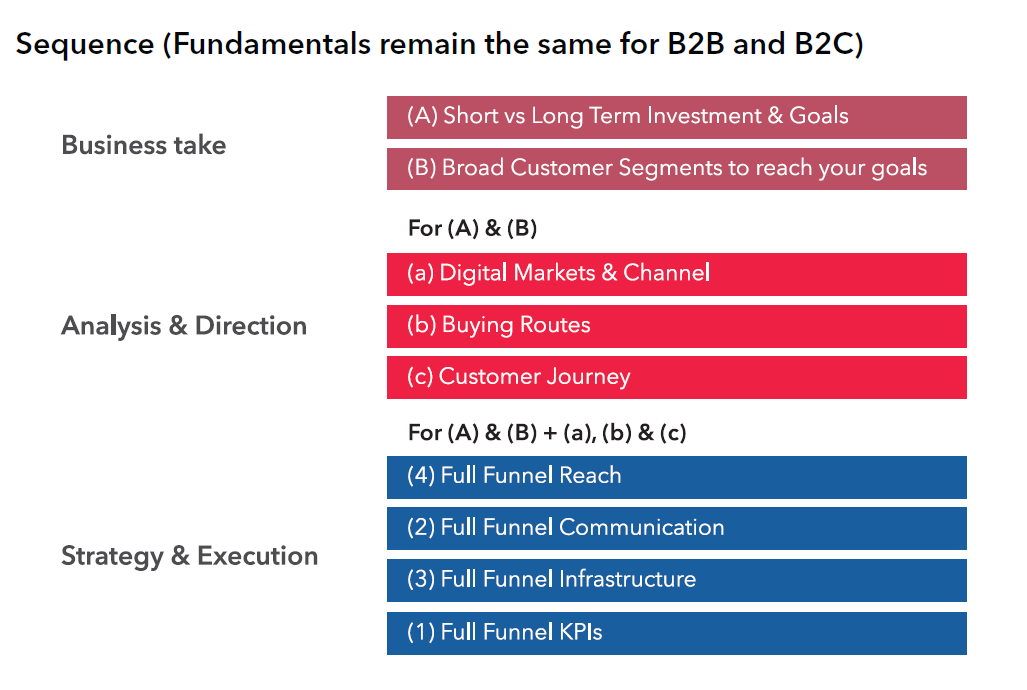
3. The Sequential Flow of Execution
Follow this sequence to ensure your efforts are built on a solid foundation, reducing wasted spend and maximizing impact. (See Chapters [15](/chapter-15) & [16](/chapter-16))
- Foundation: Start with your business goals and define your Right to Win.
- Audience: Clearly identify your target segments.
- Infrastructure: Set up your website, tracking (GA4, GTM), and CRM/MAP systems *before* you start campaigns.
- Communication: Develop your core messaging and creative assets.
- Reach (Validate): Start with paid channels (like Search and Social ads) to quickly test your messaging and targeting with a small budget.
- Analyze & Refine: Use the initial data to refine your audience, messaging, and landing pages.
- Reach (Scale): Once you have a profitable CAC, scale your budget on proven paid channels.
- Expand: Layer in long-term, organic channels like SEO, Content Marketing, and Community Building for sustainable, compounding growth.
- Iterate: Continuously monitor your full funnel, identify bottlenecks (e.g., high traffic but low conversion), and run experiments to optimize.
4. Key Takeaways
- Digital is a System, Not a Tactic: It's an integrated system of Reach, Communication, Infrastructure, and KPIs. Neglecting one weakens the others.
- Strategy Before Tactics: Don’t jump into running ads without a solid foundation. Fix your infrastructure and messaging first.
- The Boring Work is the Real Work: Success isn’t in flashy campaigns; it’s in the disciplined analysis of spreadsheets, funnel data, and CAC/LTV ratios.
- Paid Validates, Organic Scales: Use paid media to get quick feedback and prove your model. Use organic channels (SEO, content) to build a long-term, low-cost growth engine.
- Integrate Sales and Marketing: Ensure a seamless handover from marketing-generated leads to the sales team, with shared data and feedback loops.
- AI is a Co-pilot: Use AI to augment your strategy, from generating copy and creative to analyzing data and personalizing campaigns. (See Chapter [18](/chapter-18))
- There Are No Shortcuts: Sustainable growth comes from methodical testing, learning, and optimization until your CAC/LTV is healthy and predictable. Review campaign playbooks and case studies to learn from others. (See Chapter [19](/chapter-19))